Death
Journey to the End of the NightDeath is a recurring physical fact and a crisis of understanding in Journey to the End of the Night. It arrives not as a clean conclusion but as blindness, despair, a failing heart, and the gradual alteration of familiar surroundings. The narrator witnesses these forms of approaching death while acknowledging that neither speech nor reflection can make it fully comprehensible: people endure, fear, and describe it, but cannot think it through to completion.
Death as a Limit
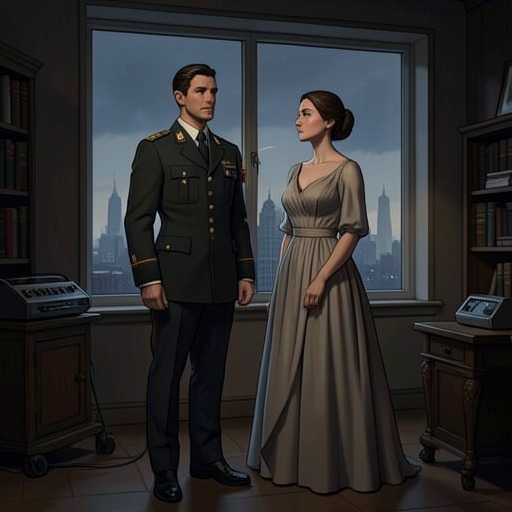
The narrator’s account of Robinson’s blindness gives death an existential force without making blindness identical to death. During the weeks when Robinson’s eyelids are inflamed, the narrator tries to comfort him with stories about his eyes and the future, even deceiving him about whether the window is open or whether it is dark outside. When Robinson removes his bandage and checks the frame with his hands, he discovers that the open window is real but that he cannot see through it. He stretches his arms into the air, trying to reach into the darkness, and the narrator realizes that reassurance no longer reaches him. Robinson has encountered a limit that leaves him alone with what has happened.
The scene’s force lies in the difference between what can be touched and what cannot be recovered. Robinson can feel air at the window, but that contact does not restore sight or offer a future he can believe in. The narrator describes the moment as an end, then widens the thought: there comes a point when even grief no longer answers a person, and the living must return among other people simply because isolation has become unbearable. Death thus shapes life before it occurs, severing a person from familiar forms of consolation and sending survivors back toward a world that will continue without resolving their loss.
Despair and the Conditions of Dying
Robinson’s despair soon takes the form of a threat to kill himself. He nevertheless continues to bear his misery, which the narrator figures as a burden too large and complicated to explain. That inability to put suffering into words matters: the distress is not presented as a momentary declaration that speech can settle, but as an experience that exceeds Robinson’s capacity to account for it.
The narrator complicates the label of cowardice that he and Robinson apply to Robinson. A person may be willing to die under some conditions but unwilling to accept the circumstances actually available; the chance of dying in the desired way may never appear. Robinson, the narrator concludes, is not prepared to die under the conditions offered, though under different conditions he might welcome death. The distinction makes survival neither proof of courage nor simple evidence of fear. It is shaped by contingency: a person can remain alive without having chosen life, because the death he could accept has not become possible.
The Past, the Body, and Mortality
In a later visit to a household where he had once treated Robinson, the narrator reflects on the way a familiar room changes even when nothing has been moved. Objects have aged, and returning to them makes their relation to death newly apparent. The past, once crowded with people and experiences that seemed commonplace, precious, or imposing, gradually becomes populated by subdued, disarmed remnants. The narrator connects this altered perception to the fear of the end, which marks both people and things while the living pursue pleasure or bread.
That reflection is followed by the sight of a seriously ill husband, lying in the same bed where Robinson had recovered from his accident. His circulation is failing, and the trouble is in his heart. The patient says plainly that he is going to die; the narrator listens to the racing heartbeat, performing the gestures expected of a doctor while recognizing that the heart cannot catch up with life. He foresees a court-ordered autopsy after the death, with neighborhood suspicions about the wife likely to return as rumor. Mortality here is at once intimate and public: a failing body, a household under scrutiny, and an official procedure that will follow death.
The patient’s experience also resists a clean passage from life into death. He appears partly withdrawn from life but cannot simply let go; he continues to breathe, and he complains that he can no longer feel his feet and is cold up to his knees. The scene keeps attention on the interval in which dying is neither complete nor avoidable. The body registers that interval even as the narrator anticipates its end.
Thinking and Speaking About Death
The narrator’s reflections insist that human beings are unable to think death through, despite seeing generations of living creatures born, labor, and die. Repetition does not produce mastery. Life continues to generate beings who meet the same broad end, while those who witness the cycle go on hoping for something beyond it. This tension—familiarity without comprehension—prevents death from becoming an abstract certainty that people have genuinely absorbed.
The narrator’s own speech makes that difficulty visible. In conversation with Abbé Protiste, he imagines a human death prolonged through a thousand distinct minutes and argues that fear and trembling would overtake memories of pleasure. He also speculates about dying together with pleasure, then recognizes that he may be indulging his imagination in a search for punishment. His talk is not presented as a settled doctrine: Protiste thinks he may have fallen ill again, and the narrator admits that he may be wrong. Death prompts attempts at philosophy, but those attempts disclose the speaker’s isolation and agitation as much as they explain mortality.
Narrative Significance
Death in these episodes is repeatedly approached through scenes of witnessing: the narrator watches Robinson discover his blindness, listens to his despair, returns to a room altered by time, and examines a patient whose heart is failing. Yet witnessing does not grant control. The narrator can offer comfort, observe symptoms, and anticipate what institutions or neighbors may do after a death, but none of those actions cancels the finality or uncertainty at stake.
The account’s movement between concrete bodies and sweeping reflection preserves a tension between what can be seen and what cannot be understood. A window is open, a patient’s heart races, and the past seems to recede; each fact is tangible, but none makes death fully available to thought. The resulting vision is neither a promise of consolation nor a claim that all suffering has one meaning. It presents mortality as a limit the living repeatedly encounter, interpret, and fail to overcome.